1940-1941 Clara Rockmore (w/ Paul Robeson) Concert Program #2
Dublin Core
Title
Subject
Description
Creator
Date
Rights
Language
Text Item Type Metadata
Text
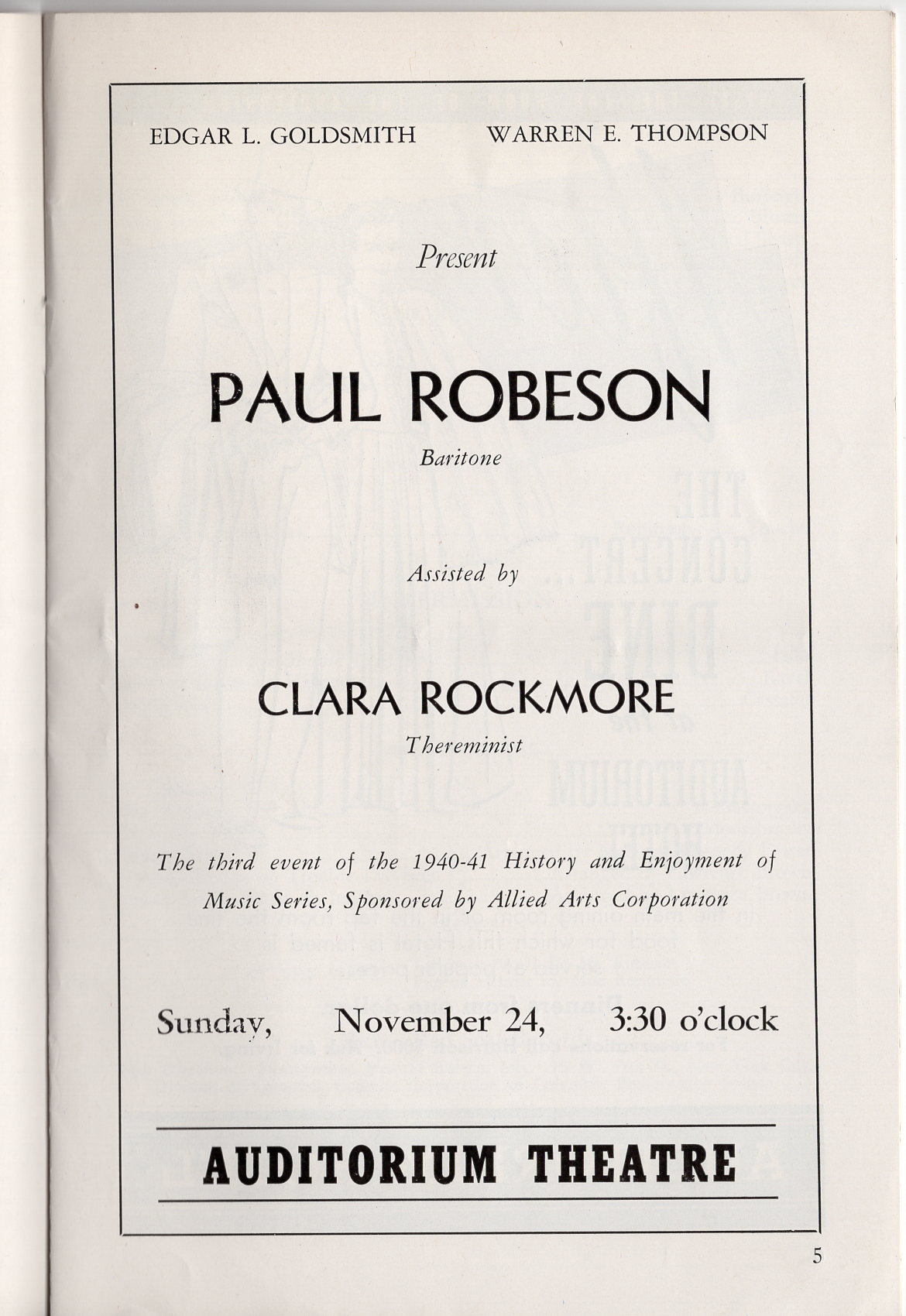
EDGAR L. GOLDSMITH
WARREN E. THOMPSON
Present
PAUL ROBESON
Baritone
Assisted by
CLARA ROCKMORE
Thereminist
The third event of the 1940–41
History and Enjoyment of Music Series
Sponsored by Allied Arts Corporation
Sunday, November 24, 3:30 o'clock
AUDITORIUM THEATRE
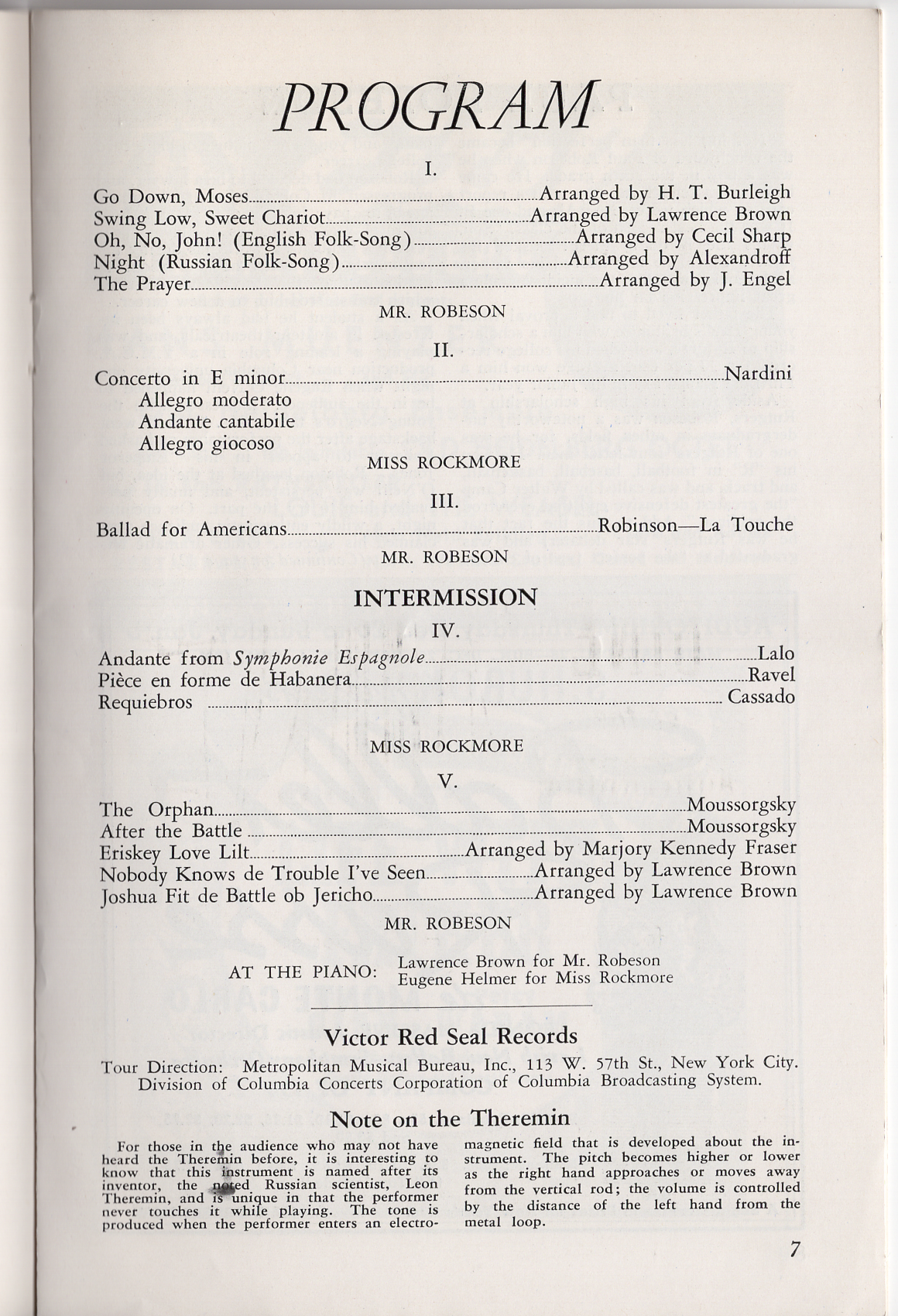
PROGRAM
I.
Go Down, Moses
Arranged by H. T. Burleigh
Swing Low, Sweet Chariot
Arranged by Lawrence Brown
Oh, No, John! (English Folk-Song)
Arranged by Cecil Sharp
Night (Russian Folk-Song)
Arranged by Alexandroff
The Prayer
Arranged by J. Engel
MR. ROBESON
II.
Concerto in E minor
Allegro moderato
Andante cantabile
Allegro giocoso
Nardini
Ballad for Americans
MISS ROCKMORE
III.
MR. ROBESON
INTERMISSION
IV.
Andante from Symphonie Espagnole — Lalo
Pièce en forme de Habanera — Ravel
Requiebros — Cassado
MISS ROCKMORE
V.
The Orphan — Moussorgsky
After the Battle — Moussorgsky
Eriskey Love Lilt
Arranged by Marjory Kennedy Fraser
Nobody Knows de Trouble I've Seeen
Arranged by Lawrence Brown
Joshua Fit de Battle ob Jericho
Arranged by Lawrence Brown
MR. ROBESON
AT THE PIANO:
Lawrence Brown for Mr. Robeson
Eugene Helmer for Miss Rockmore
Victor Red Seal Records
Tour Direction: Metropolitan Musical Bureau, Inc., 113 W. 57th St., New York City.
Division of Columbia Concerts Corporation of Columbia Broadcasting System.
Note on the Theremin
For those in the audience who may not have heard the Theremin before, it is interesting to know that this instrument is named after its inventor, Russian scientist Theremin, and is unique in that the performer never touches it while playing. Tone is produced when the performer enters an electromagnetic field that is developed about the instrument. The pitch becomes higher or lower as the right hand approaches or moves away from the vertical rod; the volume is controlled by the distance of the left hand from the metal loop.
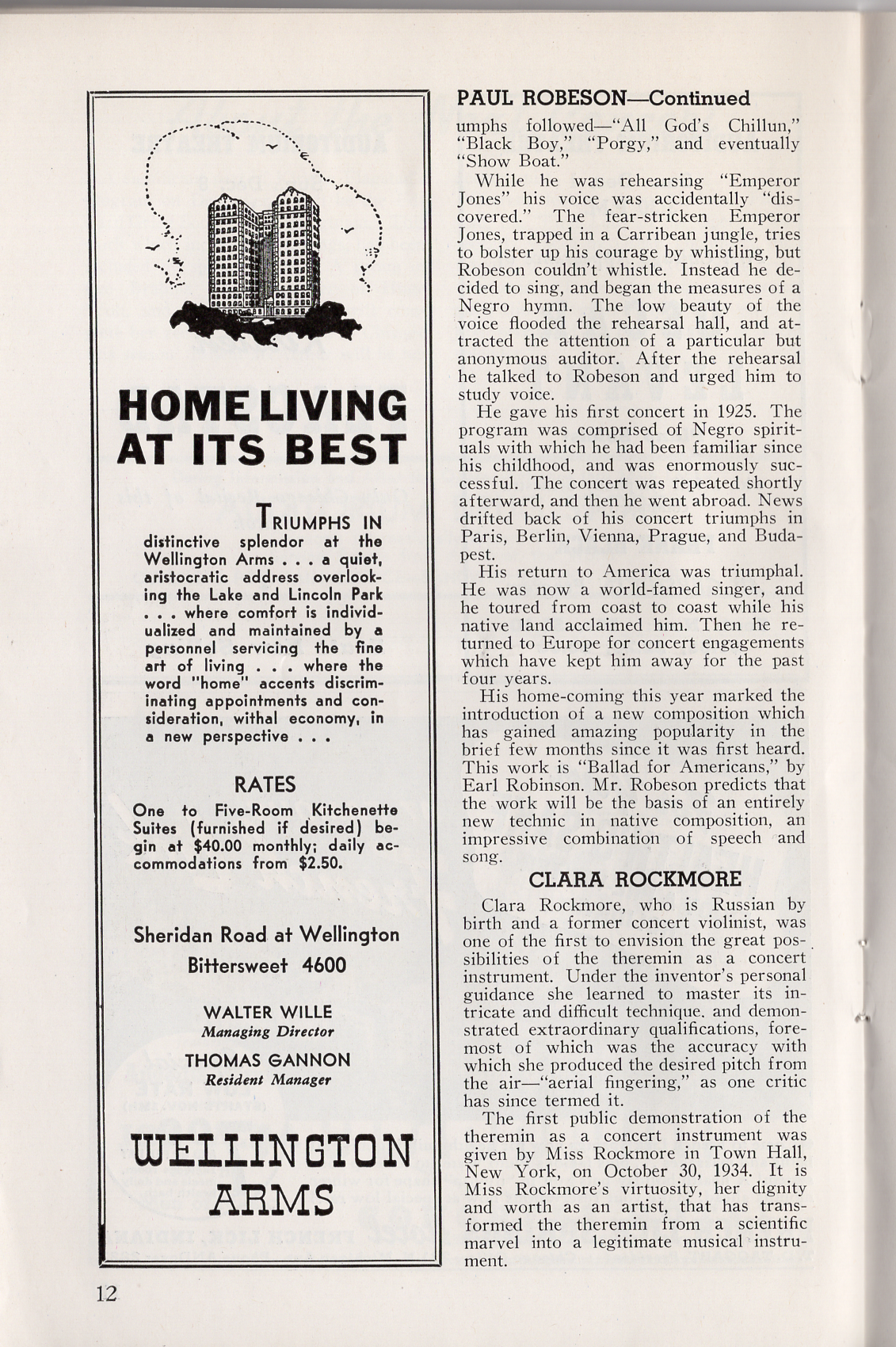
CLARA ROCKMORE
Clara Rockmore, who is Russian by birth and a former concert violinist, was one of the first to envision the great possibilities of the theremin as a concert instrument. Under the inventor's personal guidance she learned to master its intricate and difficult technique, and demonstrated extraordinary qualifications, foremost of which was the accuracy with which she produced the desired pitch from the air—“aerial fingering,” as one critic has since termed it.
The first public demonstration of the theremin as a concert instrument was given by Miss Rockmore in Town Hall, New York, on October 30, 1934. It is Miss Rockmore's virtuosity, her dignity and worth as an artist, that has transformed the theremin from a scientific marvel into a legitimate musical instrument.
Original Format
Files